
Diligence
I am DONE. It's TOO MUCH for any human to do.
That's what I texted my husband while running up a hill on Monday morning. He gets the worst of me, poor guy. It was 6am, I had an NPR interview to prep for, back-to-back coaching clients, an interpersonally challenging meeting on the calendar, and — not to be forgotten — a kid still on summer break.
I can’t do this any more, I texted.
And yet, clearly, I could — because I was running up a hill and texting him at the same time.
Diligence.
It's one of the six paramitas in Buddhism — one of the "perfections," sitting alongside mindfulness, generosity, wisdom, concentration and patience. I wasn't exuding any of those on my run, or in that text. And as for diligence, I was pursuing it in all the wrong ways.
Diligence can come out sideways on you. In Buddhism, this is called the near enemy — a quality that impersonates the real thing closely enough to fool you from the inside. For diligence, the near enemy is busyness. Push diligence too hard in the other direction and you get its opposite: failure — giving up entirely. The dangerous combination — the one I was engaging in on my run that Monday morning — is pushing the gas and the brake at the same time.
It reminds me of learning to drive my 1986 Volvo stick shift. If you don't learn how to shift gears, you'll burn out the clutch. At the very least, you'll sound terrible doing it.
But that's the first step in diligence, isn't it? To notice when — and where — you're starting to sound bad.
Want to listen to the audio of Diana Hill’s live “Word of the Week” talk?
Join Diana’s FREE Community Circle to get all of Diana’s live talks and meditations on demand.
#1 Notice When You're Sounding Bad
Diligence, as I define it, is pointing your heart and your effort in the same direction — noticing when you're off, and re-orienting, again and again.
But you can't tell you're off unless you listen. Like a guitarist plucking a string, checking whether it's in tune or out. You have to listen to yourself.
Listen to how you're talking to the people you love.
Listen to how you're talking to yourself.
Listen to your body — it's telling you to speed up or slow down.
Listen to your life — it's calling you toward something different.
When I work with clients, I often draw this out as a diagram: a line across the page, one direction pointing toward values, the other pointing away.
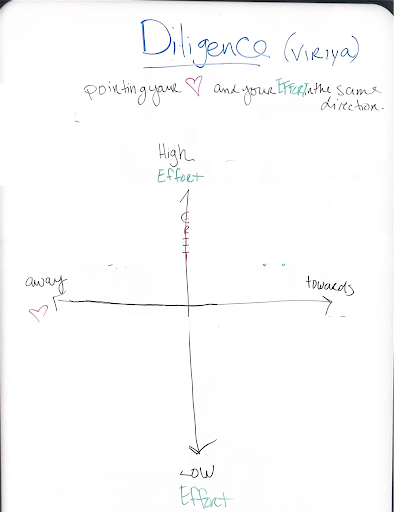
Do you know what it sounds like — what it feels like — when you're moving toward your values versus away from them? Moving away, you might feel a ping of regret. (I shouldn't have unloaded on my husband that way. I wish I'd prepped more for that interview.) Moving toward, you might feel a ping of vitality. (Writing this now, for instance, makes me feel like I'm in integrity — not hiding my imperfections, but being honest about my own fallible, unwise efforts.)
Which brings us to step two.
#2 Explore Your Busyness
Diligence isn't all effort, all the time. It's right effort.
Researchers Wrosch and Miller spent years studying what happens to people who can't let go of goals they'll never reach. In one study, adults who struggled to disengage from unattainable goals showed unusual cortisol patterns — their levels never came back down by the end of the day; they just stayed elevated. In a related study, adolescents who couldn't let go of unreachable goals showed rising levels of C-reactive protein over the following year, which is a biomarker for inflammation. Refusing to let go doesn't sound bad. It feels bad and shows up in your body.
This is what's happening when you play with diligence’s near enemy–busyness. You take on more than is humanly possible, often driven by self-stories (your productivity is your worth) or by plain avoidance (working is just easier than facing the high-value, high-effort thing you actually want to pursue). It's a lot harder to pitch yourself to your dream client than it is to sort through and delete forty newsletter emails.
What falls into your burnout category? What unattainable, unrealistic goals are you gripping? What stories are keeping you busy? What are you avoiding by staying busy?
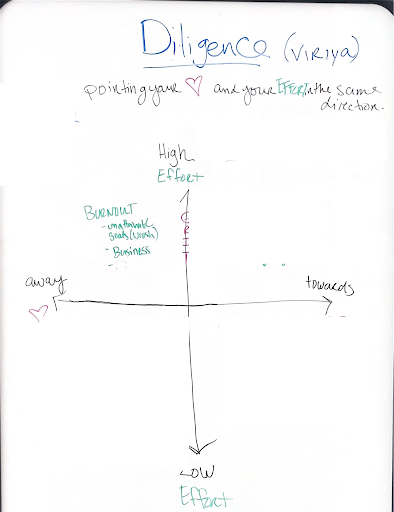
The bigger question I'd ask isn't can you push through. It's why do you want to. Is it aligned with what you value? Do you feel alive while doing it? Effort without direction is just busyness running you faster to where you don’t want to go.
#3 Beware of False Refuges
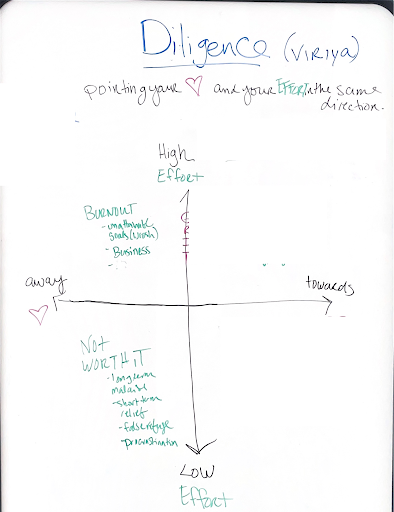
There's a vicious cycle that shows up when you push yourself relentlessly and never spend time in the margins — in rest, play, pleasure– savoring. You fall into what I call junk food rest: activities that are easy to do but add nothing to your life. These are false refuges.
Honestly, a false refuge for me is complaining to my husband. Easy to do. Adds nothing. And yet, I do it often. Another favorite: talking about how I need to change, without changing anything. It feels like I'm "working on it," but really I'm just circling the runway like a plane that never lands. Other false refuges you may relate to include: scrolling, planning, organizing, making to-do lists, — all in the name of perfectionism, control, or procrastination, none of it actual diligence.
What are your false refuges? Fill them in.
#4 Identify Where Your Effort and Heart Point in the Same Direction
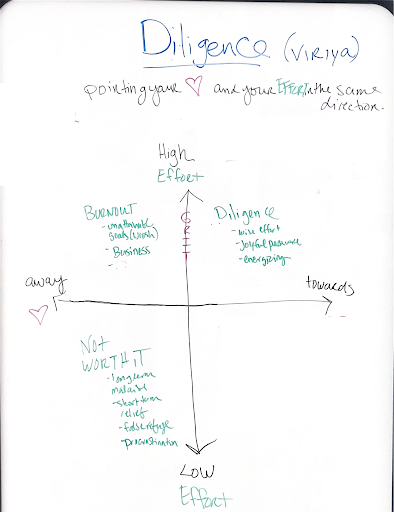
What actually plots in the diligence category for you? What behaviors — including mindsets — count as joyful perseverance? The kind that get easier over time instead of harder, that feed you with vitality even while asking something of you, that take real effort but are worth it in the long run?
Daily pages toward the book you're writing? Daily appreciation rather than complaints spoken to your partner? Daily time being quiet with yourself? This is wise effort — the practice of diligence in action.
Savor
True refuges are the behaviors and places that restore you at a deep level. UCSF psychologists Elissa Epel and Alexandra Crosswell call this deep rest — it might be moving your body outdoors, tending your little basil plant on the kitchen counter, or experiencing life the way you did as a kid: playful and spontaneous. Researchers who study recovery from work have found that people who genuinely detach and unwind after work show up the next day with more vigor and more engagement. Rest, done on purpose, is wise diligence.
Savoring means staying in the activity long enough for it to make new connections in your brain. As Rick Hanson says, what fires together wires together — you're wiring in contentment, peace, satisfaction.
What goes in this category for you?
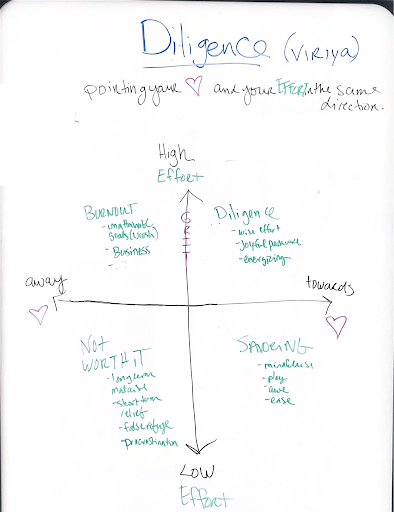
When you engage in diligence — the true sense of the word — you notice the moment you've drifted into unwise effort. You can hear it and feel it. And you return, again and again, toward pointing your energy at your heart, savoring the good of your life along the way.
The word for Diligence in Sanskrit is “Viriya” with the root “vīra” which means warrior. A true warrior plants their feet where they are–and points their arrow in the direction they want to head.
So, on my run this morning, instead of texting my husband how overwhelmed I am, I texted him I love him, listened to my favorite playlist instead, and figured out how to put this all into a blog post for you. Wise Diligence.