
Endings
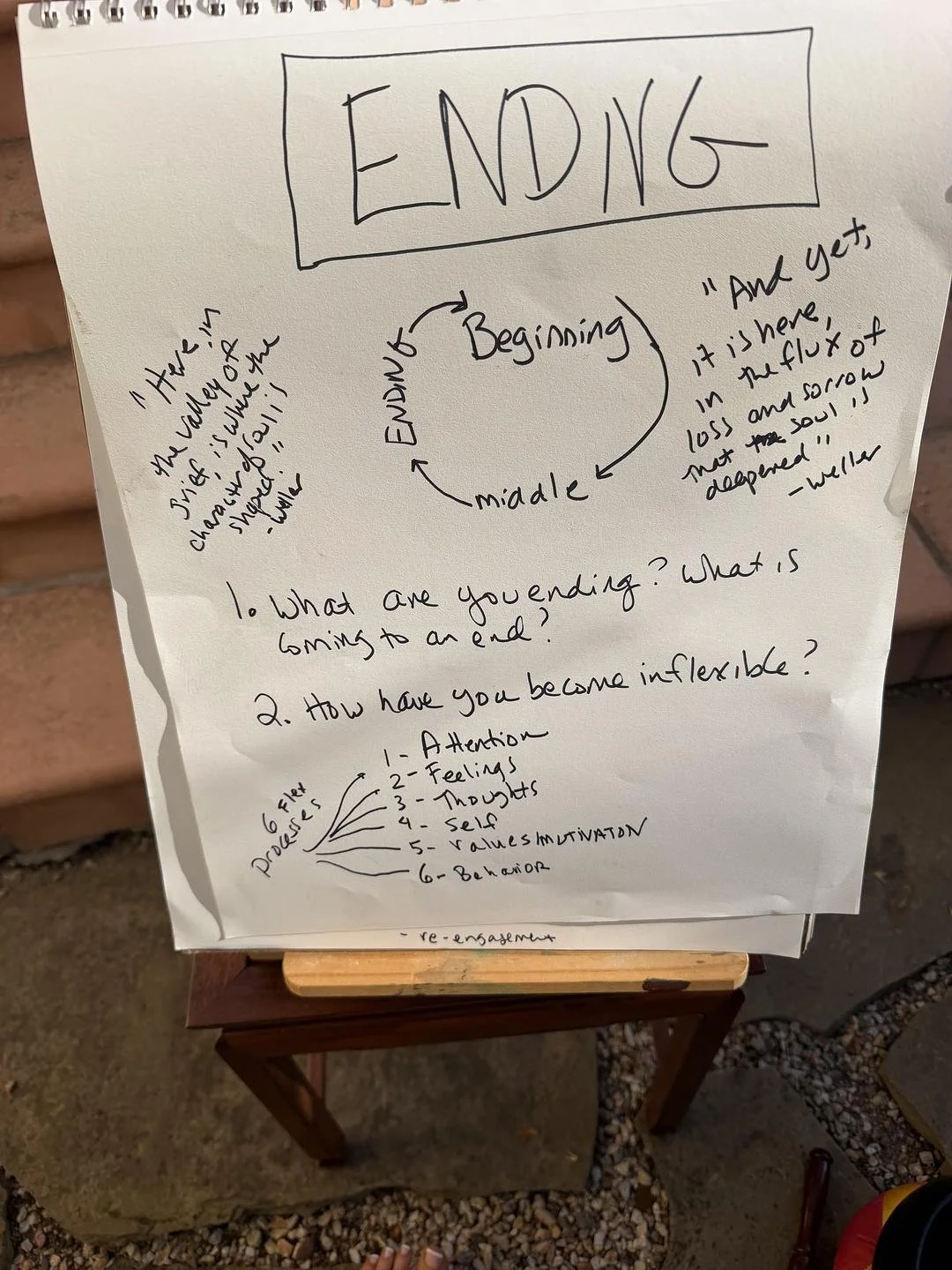
I've been going through a lot of endings this year, as we all have. And what I've discovered for myself — and in working with many, many clients — is that we are not very good at endings. Endings aren't the end of a thread or the end of a line. There's a beginning, and then there's a middle, and then there's an ending, and we keep going around and around and around that cycle of continuation.
Think about an ending you're going through right now, are you holding on too tight?
We're not very good at this
We tend to get psychologically inflexible right at the end of things, and that inflexibility shows up in six places:
Attention — we replay the past over and over again. What if I'd done this differently, or that differently — would it have ended differently?
Feelings — I can't do it, this is too painful, I just want to rush through it or skip over it or ignore it.
Thoughts — we add so much story to the ending of things. So much story.
Self — we get identified, over-identified, with something, and can't see ourselves as fluid and changing over time. Self is context.
Motivation — we lose track of what we actually value, and the chase or the attachment takes over instead.
Behavior — the inflexibility shows up in what we actually do, or can't stop doing.
You stay on too long — you know that feeling in your body, this is coming to an end, but you keep going anyway. And your motivation gets co-opted, so you're no longer pursuing your actual values, just the chase, the attachment to keeping it.
Want to listen to the audio of Diana Hill’s live “Word of the Week” talk?
Join Diana’s FREE Community Circle to get all of Diana’s live talks and meditations on demand.
The action crisis
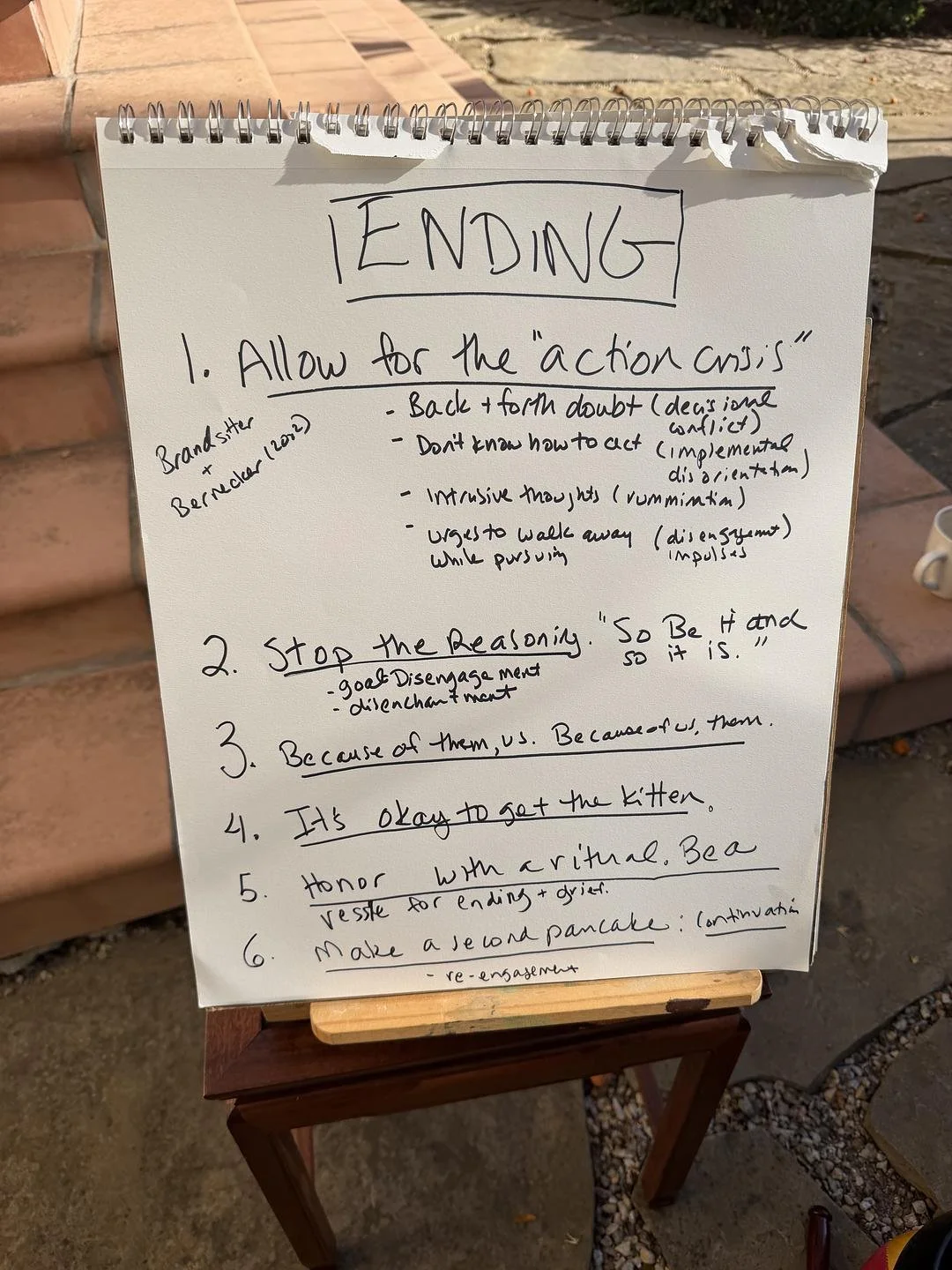
There’s a construct in psychology called the action crisis (Brandstätter & Bernecker). It's what happens when you're persisting toward something and it's become clear you need to start disengaging — a relationship that isn't working the way it needs to, a job, a habit — and you know, somewhere, that it needs to end or shift, but you can't quite do it.
It has four qualities:
Decisional conflict — you go back and forth, back and forth. Ready to end it, then you pick it back up, then you're ready again.
Implemental disorientation — you get confused, even though you've ended and begun plenty of things in your life. A real I don't even know how to do this feeling.
Rumination — the intrusive thoughts, going back over it again and again.
Disengagement impulses — the urge to just drop it all, run away, hide. In my case, hop on a plane to Blue Spirit Costa Rica.
So what do we do with an action crisis? First, just acknowledge that endings don't happen like a break. There's this internal conflict, and it's okay for that to be happening — it's actually normal. So normal, psychologists made a construct to describe it. But then, how do we move from the churning, the struggle with the end, into something different? Into true transformation, into beginning anew, into seeing endings as part of the cycle: the beginning, the middle, the end, the beginning again?
Stop the reasoning
The first move is to stop the reasoning. Instead of staying caught up in your head, land in the truth of what is. As Trudy Goodman said to me when I called her distraught about an ending I was going through: So be it. And so it is.
Maybe it's a work project you need to end. Or a relationship. Or you have lost a physical ability that you once relied on. A kid going off to college and your whole life shifting around that. Try this simple mantra every time your head wants to keep going around on it.
So be it. And so it is.
Because of them, us. Because of us, them.
The next move is to remember that everything that ends, still continues, in you and your eactions. There's a line written on the stairs of my son's middle school: because of us, them. Because of them, us.
Honor what's coming to an end for you as something that has changed you, and that change will keep going. Think about what's shifting in your life, and know you carry it forward — the way a sunflower carries the whole energy of the seed into the bloom, and the bloom turns back into a seed. Can you honor that with gratitude, and ask how you'll offer what's ended in a new form?
It's okay to get the kitten
I grew up with a lot of animals — dogs, cats, guinea pigs, rabbits, hamsters, and at any given time somebody else's snake we were watching. Which meant a lot of endings. Snakes that got loose. My mom had a habit: whenever an animal died, we'd stop at the Humane Society on the way home and pick up a new one.
That's the next teaching — it's okay to get the kitten. It's okay to go into another relationship, ok to try again when you lose a pregnancy, okay to pursue new social groups when your kid leaves for school and your time opens up. But the important thing to know is: the kitten you get does not replace the cat you lost. It's going to be different. You don't replace what came before — but maybe this little kitten grows into something of its own, something different and beautiful in its own form.
Create a ritual
Ritual has been part of religious and spiritual traditions forever, honoring endings and beginnings. Many of us have lost our connection to ritual, but we can re-engage them by bringing the sacred back. When you create a ritual around the end of something, you physicalize it, honor it, and feel a greater sense of completion. Here’s a recent ritual I co-created with my friends to honor endings. You and you get to create your own. Co-create it. Make it yours. Or remember the ones already passed down to you.
Make a second pancake
Then, finally, continuation — what we call in our house the second pancake. Re-engagement with something new is a real part of hope and regeneration and growth in psychology. You can always make another pancake. It's not the same as the first, but it's a continuation of you.
We are constantly moving through beginnings and middles and endings and beginning anew. Francis Weller, who writes about grief, says it better than I can: "And yet it is here, in the flux of loss and sorrow, that soul is deepened. Here in the valley of grief is where the character of the soul is shaped."
The practice
Word of the week is endings. This week, notice where you're psychologically flexible or inflexible around one, and try:
Allow for the action crisis. The back-and-forth doubt, the confusion about how to act, the rumination, the urge to walk away while you're still pursuing it — all four are normal, not a sign you're doing it wrong.
Stop the reasoning. So be it. And so it is.
Remember: because of them, us. Because of us, them. Nothing ends without continuing in another form.
It's okay to get the kitten. Start the next thing if you need to — just don't ask it to replace what you lost.
Honor it with a ritual. Be a vessel for the ending, and for the grief.
Make another pancake. Re-engage. It's just a pancake.