
Relief
When I was in third grade, I used to catch butterflies. My best friend Katie had a field of lantana outside her house — that little orange and red flower that grows all over Southern California — and lantana is a butterfly magnet. We'd run around the yard, find one, put a jar over it, and bring it inside.
And I always noticed something happened once that butterfly was in the jar. It lost all of its magic.
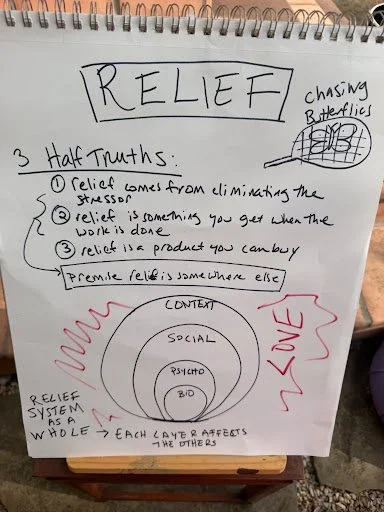
Relief is like that. As soon as we try to force it or catch it, we lose the relief of it just coming to us.
Want to listen to the audio of Diana Hill’s live “Word of the Week” talk?
Join Diana’s FREE Community Circle to get all of Diana’s live talks and meditations on demand.
Relief is a tricky word
Last week our word was endings, and so many of you wrote in about something that came along with endings: relief.
Relief is a tricky word in psychology, because so much of our relief-seeking actually gets us more entangled in our pain. Think of all the things we do to feel better that end up making it worse.
There are three half-truths about relief:
Relief comes from eliminating the stressor. I had a colleague who, every time I asked how she was doing, would say, "Once this month is over… once this deadline is done… once we're through the holidays… once the kids are back in school — then it'll get better." And every time I saw her, there was a new thing that was going to end. Sometimes the pain you're in isn't going to change. Sometimes you're choosing to be in something painful because it matters to you. There will always be stressors. So how can you find relief even with the pain?
Relief is what you get when the work is done. As someone with a PhD, this was my story: as soon as I finish this, then I can rest. And when I finally got there, I'd just spin in the anxiety of it all. When I started practicing yoga at 17, my teacher Eddy would have us lie down in savasana in the middle of class. It felt so bizarre — isn't that for the end? I get it now. Relief is here. It's now.
Relief is a product you can buy. We're all so stressed and busy, and there's a whole industry poised to sell us relief in a box. But relief isn't something you can buy. It's already here.
So our practice isn't to catch the butterfly. It's to find the spaces where the butterfly lands. Think of something that's stressing you out right now. When have you actually felt relief around it? It's usually not where you'd expect.
You are a living, breathing ecosystem
I like to look at relief through a bio-psycho-social-contextual model — it comes from psychological science and process-based therapy. The idea is that you're a living, breathing ecosystem, and when you're in pain, you can create conditions that support the relief that's already here: in your body, in your mind, in your relationships, and in your context. And I'd add the bigger context that holds all of it: love.
In your body
Your body has so many supports for relief, and part of the work is figuring out which ones work best for you. Deep, slow breathing has so much science behind it — even five minutes helps. Researchers have compared people in their twenties with people 65 and older, and slow breathing was especially beneficial for the older adults.
Singing and humming bring relief too — I think we've lost a lot of our traditions of singing together. My friend, the poet Rosemary, writes a poem every day, and one this month was about singing a lullaby to the anxiousness nested in her chest. Using your voice activates your vagus nerve. So does deep breathing. So does movement — going for a walk.
You don't need to buy anything. You have a whole nervous system that can move into a deeper rest space, even when you're under stress.
In your mind
In ACT we talk about clean pain and dirty pain. And I know dirty pain personally. Clean pain is: this is hard. I'm doing a hard thing. I'm in a hard stage of life. Dirty pain is what happens when we stir it up — resisting it, suppressing it, adding all sorts of story to it.
There's good research on this. When people try not to feel something — even physical pain — their cortisol and heart rate go up. Trying not to feel stressed makes you more stressed. And with chronic pain, the best predictor of how well people do isn't how intense their pain is. It's how willing they are to accept it.
Or, as Oliver Burkeman puts it: stop being your own worst enemy.
Yesterday a client told me how much it helps to get perspective — to zoom out. Instead of being in the figuring-it-out, you create a bigger space for whatever you're experiencing. It's the difference between putting a drop of pain in a glass and putting a drop of pain in the ocean.
With each other
I started my Tell the Truth series because I believe in the power of truth-telling. Not confessing — confiding. First confiding in ourselves: what's true for me? And then confiding our truths, even our secrets, in someone else. That's so much of what therapy is. It's what good friends are. I can't wait to go on a walk with her so I can tell her what's going on.
There's research where people holding a secret were asked to look at a hill and guess how steep it was, and how long the trail up it was. If you're keeping a secret to yourself, the hill looks steeper and the trail looks longer. So much of our relief comes from sharing what we feel shame around with someone who's emotionally supportive. You're not carrying it alone.
Relief also comes from generosity. In Meditations for Mortals, Oliver Burkeman suggests acting on a generous impulse the moment it shows up — not trying to become more generous than you are, just noticing when you naturally feel it, and not overthinking it.
New relationships are like little seeds: they need frequent watering, lots of small, impulsive acts of generosity. Our deeper relationships need deep watering: deep generosity, deep appreciation.
I was working in a coffee shop yesterday and overheard a mother and daughter. The mom was in her eighties — bright lipstick, big red earrings — and they were talking about where she could find some grounding, some relief from her anxiety. As they were leaving, I flagged them down: You two have such a beautiful relationship. Why don't you come to my meditation tomorrow? I'll text it to you.
Impulsive acts of generosity bring you relief. And there's a chance they bring someone else relief too.
In your context
Sometimes relief comes not from changing anything, but from shifting where you place your attention. The stressors are still there, but the context is different.
Being in nature — even looking at images of nature — has been shown to give your attention some relief. And what matters most isn't how long you're out there or who you're with. It's how restorative it feels to you.
Nirodha
In Buddhism, the third noble truth is nirodha: relief is possible, here and now.
When you start watching for it, you might be surprised. It's not getting rid of anything. It's not figuring anything out. It's relaxing into what already is.
The practice: 6 ways to let the butterfly land
Watch for relief. This week, be an observer. When do you feel even a little relief? Where are you, who are you with, what are you doing? Don't chase it — just notice where the butterfly lands.
Try the butterfly breath. I learned this from Annette, one of my meditation teachers at Blue Spirit. Cross your hands at the thumbs to make a butterfly and rest it on your chest. Breathe in and open your wings. Breathe out and close them. Notice the relief of simply making contact with your body.
Use your voice. Hum, sing, sing a lullaby to whatever's anxious in you. Your voice is a direct line to your vagus nerve.
Keep the pain clean. Pick one thing that's hard right now. Name the clean pain: this is hard. Then notice what you're adding — the resisting, the suppressing, the story. Zoom out. Drop it into the ocean instead of the glass.
Confide one truth. Tell yourself what's actually true. Then tell someone who's on your side. You don't have to carry it alone.
Follow a generous impulse. The next time you feel the urge to give — a compliment, a text, an invitation — act on it right away, before you overthink it.
Bonus: change your context. Step outside, find a window, or even pull up a photo of a place you love. Notice what's most restorative for you.
If this landed for you, send it to someone who's waiting for relief to arrive "once this is over." And come practice with us — we gather every week, online and in person in Santa Barbara, at drdianahill.com/community.
Research mentioned
Slow breathing and vagal tone in younger and older adults: Magnon, Dutheil & Vallet, Scientific Reports (2021) — https://pmc.ncbi.nlm.nih.gov/articles/PMC8481564/
Acceptance-based approaches for chronic pain: Martínez-Calderón et al., Journal of Pain (2023) — https://pubmed.ncbi.nlm.nih.gov/37748597/
Secrets and the burden of carrying them: Slepian, "The New Psychology of Secrecy" (2024) — https://www.psychologicalscience.org/news/2024-march-secrets.html
Nature and attentional restoration: Berman, Jonides & Kaplan, Psychological Science (2008) — https://dx.doi.org/10.1111/j.1467-9280.2008.02225.x
Oliver Burkeman, Meditations for Mortals (2024)
Stop the reasoning
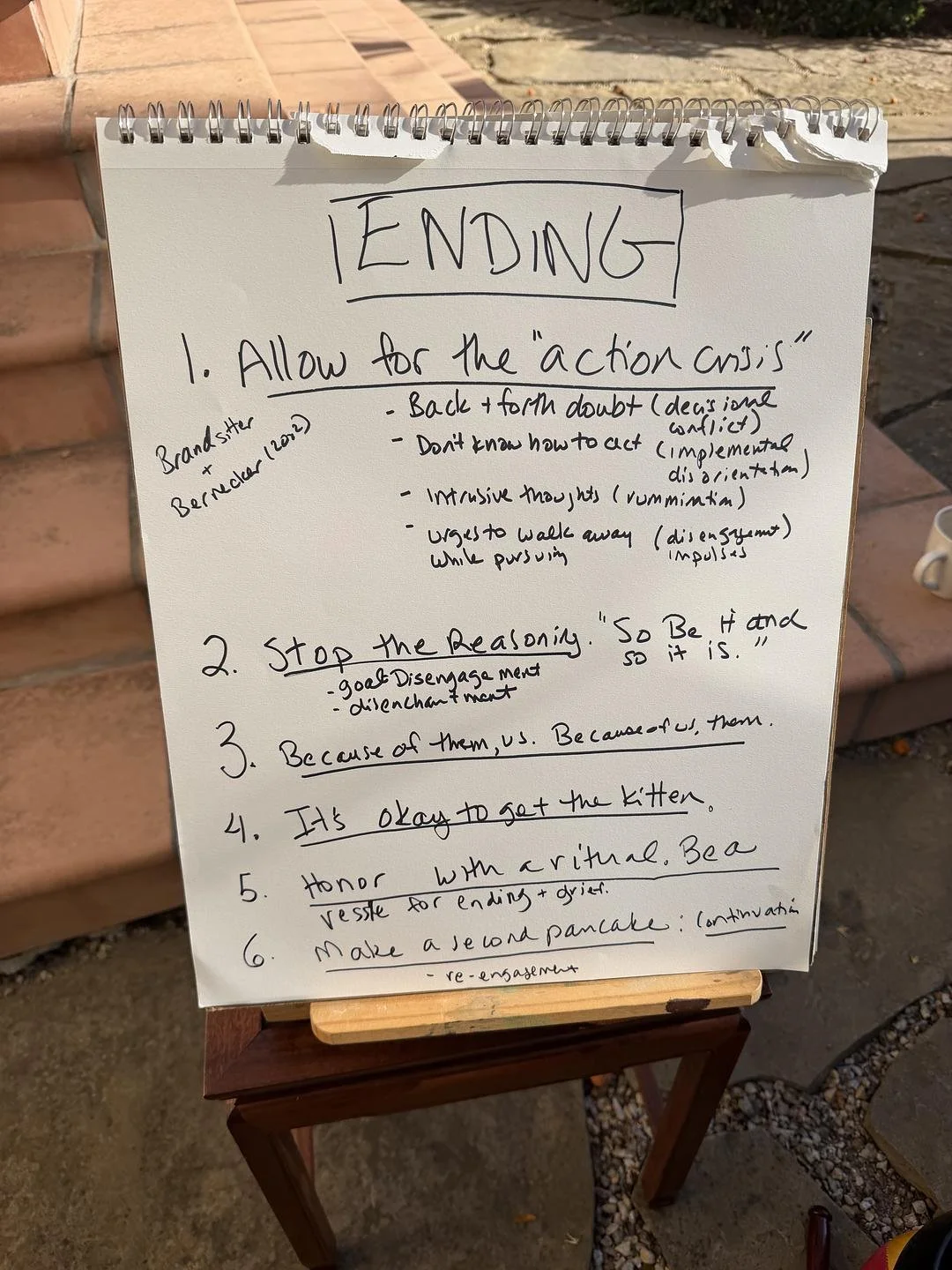
The first move is to stop the reasoning. Instead of staying caught up in your head, land in the truth of what is. As Trudy Goodman said to me when I called her distraught about an ending I was going through: So be it. And so it is.
Maybe it's a work project you need to end. Or a relationship. Or you have lost a physical ability that you once relied on. A kid going off to college and your whole life shifting around that. Try this simple mantra every time your head wants to keep going around on it.
So be it. And so it is.
Because of them, us. Because of us, them.
The next move is to remember that everything that ends, still continues, in you and your eactions. There's a line written on the stairs of my son's middle school: because of us, them. Because of them, us.
Honor what's coming to an end for you as something that has changed you, and that change will keep going. Think about what's shifting in your life, and know you carry it forward — the way a sunflower carries the whole energy of the seed into the bloom, and the bloom turns back into a seed. Can you honor that with gratitude, and ask how you'll offer what's ended in a new form?
It's okay to get the kitten
I grew up with a lot of animals — dogs, cats, guinea pigs, rabbits, hamsters, and at any given time somebody else's snake we were watching. Which meant a lot of endings. Snakes that got loose. My mom had a habit: whenever an animal died, we'd stop at the Humane Society on the way home and pick up a new one.
That's the next teaching — it's okay to get the kitten. It's okay to go into another relationship, ok to try again when you lose a pregnancy, okay to pursue new social groups when your kid leaves for school and your time opens up. But the important thing to know is: the kitten you get does not replace the cat you lost. It's going to be different. You don't replace what came before — but maybe this little kitten grows into something of its own, something different and beautiful in its own form.
Create a ritual
Ritual has been part of religious and spiritual traditions forever, honoring endings and beginnings. Many of us have lost our connection to ritual, but we can re-engage them by bringing the sacred back. When you create a ritual around the end of something, you physicalize it, honor it, and feel a greater sense of completion. Here’s a recent ritual I co-created with my friends to honor endings. You and you get to create your own. Co-create it. Make it yours. Or remember the ones already passed down to you.
Make a second pancake
Then, finally, continuation — what we call in our house the second pancake. Re-engagement with something new is a real part of hope and regeneration and growth in psychology. You can always make another pancake. It's not the same as the first, but it's a continuation of you.
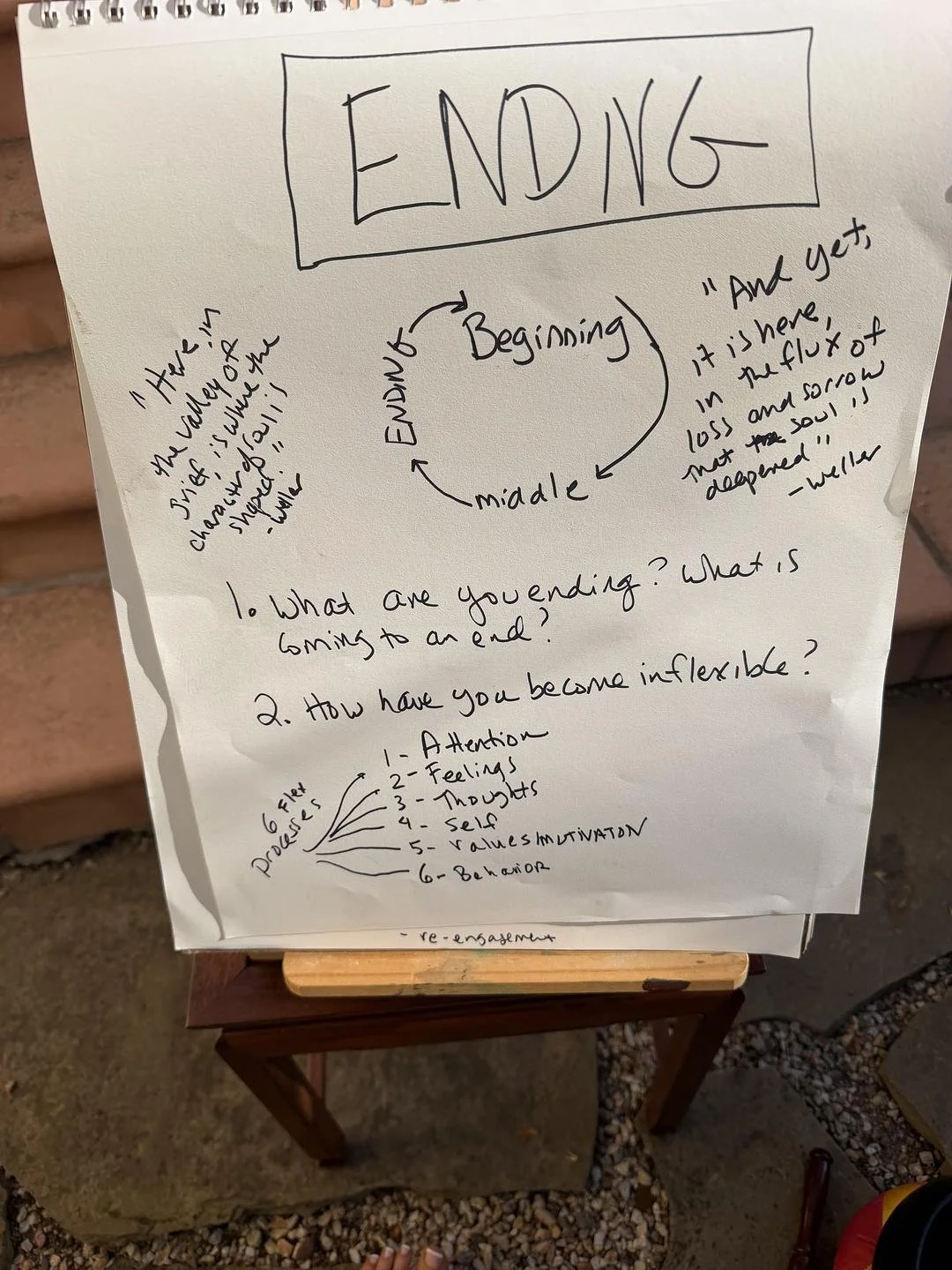
We are constantly moving through beginnings and middles and endings and beginning anew. Francis Weller, who writes about grief, says it better than I can: "And yet it is here, in the flux of loss and sorrow, that soul is deepened. Here in the valley of grief is where the character of the soul is shaped."
The practice
Word of the week is endings. This week, notice where you're psychologically flexible or inflexible around one, and try:
Allow for the action crisis. The back-and-forth doubt, the confusion about how to act, the rumination, the urge to walk away while you're still pursuing it — all four are normal, not a sign you're doing it wrong.
Stop the reasoning. So be it. And so it is.
Remember: because of them, us. Because of us, them. Nothing ends without continuing in another form.
It's okay to get the kitten. Start the next thing if you need to — just don't ask it to replace what you lost.
Honor it with a ritual. Be a vessel for the ending, and for the grief.
Make another pancake. Re-engage. It's just a pancake.