
Self-Doubt
Who do you think you are?
That's the voice of self-doubt. And here's what I want you to know this week: self-doubt isn't good or bad. It isn't something you're going to escape. And if you're doubting yourself, it may be a sign you're onto something.
Part of living a larger life is self-doubt. It's something I work on with my clients, and something I'm working on in my own life. Maybe you end something, then you feel relief…then self-doubt creeps in.
Want to listen to the audio of Diana Hill’s live “Word of the Week” talk?
Join Diana’s FREE Community Circle to get all of Diana’s live talks and meditations on demand.
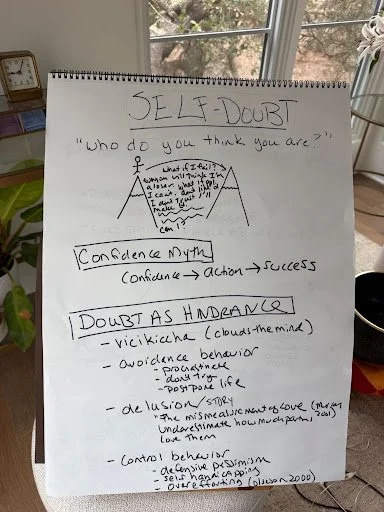
The river of doubt
I work with a lot of high performers — founders, entrepreneurs, people who have to go out and pitch themselves and convince others to invest in what they're building. (Same as you might when you start dating again, or start a new job.)
This week, one of them said something I had to write down. I was looking at her thinking, you're so successful, you've made it. And she said: "When I think about doing this thing, I think everyone will think I'm a loser. I feel sad and alone, and I avoid doing it."
Life often feels like you are standing on a cliff. You want to get to the other side of something. And between where you are and where you want to be is a river of doubt. What if I fail? Everyone will think I'm a loser. I can't do it. I don't trust myself.
The confidence myth
Here's what we're taught: first you have to be confident. There are endless books and trainings and leadership programs on building confidence. Confidence leads to action, action leads to success, and we look at people who seem confident and assume that's how they got there.
I want to reverse-engineer that, because it doesn't really work that way. In fact, too much confidence can get in your way.
When doubt is a hindrance
In Buddhism, doubt is one of the five hindrances — the things that cloud your mind if you believe them. The Pali word is vicikicchā (vih-chih-KITCH-chah).
Doubt becomes a hindrance in three ways.
You avoid. When you doubt yourself, you procrastinate. You postpone. You don't try. I'll start when I'm more confident. And so often it's social: What will people think of me? That one gets me a lot — even when the thing is exactly what I want to do.
You get caught in the story. We doubt ourselves, then misread the signals in a way that reinforces our story. In one study I love is called "The Mismeasure of Love" (Murray and colleagues, 2001), people with more self-doubt underestimated how much their partners loved them — and that set off a whole ripple of problems. We doubt, we create story, we reinforce the doubt.
You try to control it. This can look like defensive pessimism — telling yourself the negative version of how it'll turn out, so you're protected if it does. Or self-handicapping — creating conditions so you won't succeed. Or over-efforting — overcompensating, overachieving, putting way too much in, and making it so much harder than it needs to be.
So ask yourself: Where do you want to live a larger life? And how does self-doubt cloud your mind there? What do you avoid? What story are you stuck in? What do you try to control?
When doubt helps
Not all self-doubt is bad. The research says it's not about whether you doubt — it's what you do with the doubt.
The rope skippers. In one fun study, competitive rope skippers were primed with either a little doubt or a little overconfidence before competing. The ones with a little doubt — can I do this? will I make it? — worked harder. I see this all the time in sports. My son plays football, and his team had been winning every game. Their last game, they started out winning, got a little overconfident, and let their guard down.
The therapists. There's a whole body of research on therapists and self-doubt. One study had a title that was something like Love yourself as a person, doubt yourself as a therapist. Therapists who doubted themselves and had warmth toward themselves had clients with better outcomes. Later studies found that more experienced therapists who doubted themselves had stronger relationships with their clients.
You don't want a therapist — or anyone helping you — who never doubts themselves. Doubt is what leads us to question ourselves, check our skills, do the extra work, and adjust.
The middle path
I think of self-doubt as a middle path between two hindrances.
On one side: too little doubt. Thinking you already know what you're doing — which keeps you from evolving and growing. Or deciding the problem is everyone else.
On the other side: too much doubt. Avoiding, controlling, getting stuck in the story.
In the middle is doubt that's flexible — doubt that keeps you honest, curious, and moving.
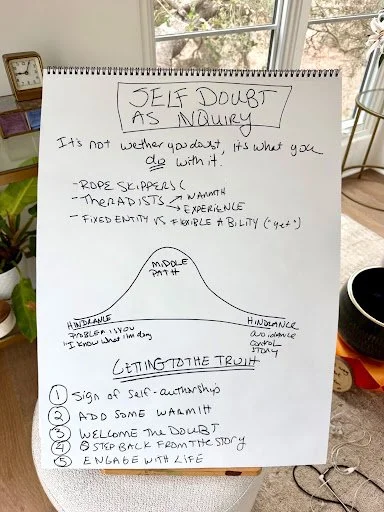
The practice: 5 ways to work with self-doubt
See it as a sign of self-authorship. When self-doubt shows up, it's probably a sign you're entering a larger life. You're not following someone else's path — you're writing your own. Your mind doesn't like uncertainty, so it's trying to control it.
Bring warmth. Remember the therapists. You can stand at the edge of something — getting on a stage, starting a blog, telling the truth to someone you're afraid to tell — with doubt and warmth. You don't have to change the doubt. You can change how you relate to yourself with it.
Welcome the doubt as inquiry. Ask yourself, Who do I think I am? — but also: Do I have the skill set? Am I missing something? Do I need more preparation? Let doubt do its useful work.
Step back from the story. Notice when you've slipped into defensive pessimism, self-handicapping, over-efforting, or misreading the signals. That's the story, not the truth.
Engage with life, doubt included. Self-doubt is part of being human. I have it. You have it. The person next to you at the grocery store has it. The most successful person you can think of probably has loads of it. It's your mind trying to control the uncontrollable — and, every so often, helping you out.
Know someone standing at the edge of the cliff right now? Send this to them. And come practice with us — we gather every week, online and in person in Santa Barbara, at drdianahill.com/community.