
So, I lost my voice somewhere in Ohio.
I was training therapists at ACT Bootcamp with Steven Hayes. Nonstop talk, talk, talk, talk, talk. Toward the end of the training, people were asking me questions and I was getting raspier and raspier and raspier. I flew home, woke up the next morning, opened my mouth — and nothing came out.
Nothing. For two whole days, no sound came out of my mouth. To be honest it was a blessing.
It stopped me long enough to really think about this word. Voice. The ways we lose it, and how we find it again.
Want to watch the video of Diana Hill’s live Sangha talk?
Join Diana’s FREE Community Circle to get all of Diana’s live talks and meditations on demand.

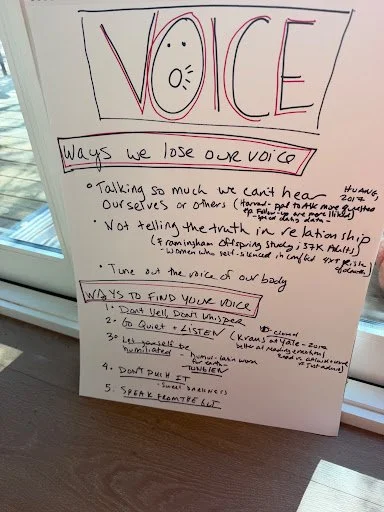
How We Lose Our Voice
We talk so much we can't hear ourselves
One way we lose our voice is that we're talking so much we don't hear ourselves anymore. We are building our argument, or a caricature of who we are. Eventually, if you are like me, you might get sick of your own voice — the same story we've been telling, the same complaints we've been complaining about, the same talk that has lost its spark.
So much talking doesn’t just get in the way of connecting with ourselves, it prevents us from connecting with others. For example, Huang et al (2017) had people chat with strangers and secretly told some of them to ask at least nine questions, and others no more than four. The people who asked more questions — especially follow-up questions, the ones that show you actually heard the answer — were liked more.
It makes sense. Stop talking. Start listening. First to yourself, then to others.
We're not telling the truth in our relationships
If your voice is the way you express yourself — your ability to tell the truth — then another way you lose it is by not using it. Not telling the truth at work. Not telling the truth to your partner. Losing your voice with your kids or your family.
Thinking about my clients this morning (and it's only noon), so much of our work together is identifying your voice — and then figuring out how to communicate it in a way that it's heard.
In the Framingham Offspring Study, researchers followed about 3,700 adults for ten years. One of the questions they asked: when you're in conflict with your spouse, do you speak up, or do you keep it to yourself?
Women who self-silenced during conflict with their spouse were four times more likely to die over the course of the study.
And it wasn't because they were meek. It was because they thought it would help. If I don't say anything, maybe we'll just avoid this conflict. But you carry it. You carry it in your body. You lose your voice, and your body keeps the score.
We don't listen to the voice of our body
Which is the third way we lose our voice. Your body has a voice. It's voicing itself all the time–aches and pains, whole body yesses and nos, the longing to get outside and move, feeling called to rest, and we ignore it.
When you don’t listen to your body, you miss important information–embodied cognition, intuition, and eventually your body will, well, have to up the ante.
Mine got to the point where my body said, uh-uh. And it just shut down.
Doctor's Orders: Five Ways to Find Your Voice
So, if you lose your voice, what is the best way to get it back? Here’s a few lessons I learned this past week that apply to the physical voice box, but also to your metaphorical one.
1. Don't yell, don’t whisper
The first thing I did is what you probably do when something goes wrong with your body: I asked ChatGPT. It recommended two things: don't yell and don’t whisper.
Yelling is forcing it. Overstating, trying to make people finally hear you. It strains your voice. But so does staying hushed.
It turns out whispering can strain your vocal cords too. In one study published in the Journal of Voice, doctors scoped 100 patients with voice problems while they talked normally and then while they whispered. In 69% of them, the throat squeezed harder when they whispered.
Think about the ways you might be yelling and getting nowhere, or maybe where you are whispering and it’s straining you. Not being straightforward. Halfway saying you want something. Halfway stepping into a way of living and being — hinting at it so softly you can claim you never said it.
If you can't yell and you can't whisper, how do you communicate? That question alone is worth sitting with.
2. Go quiet and listen
At first I resisted my voice. This was hard. I wanted to talk. But eventually I took being quiet on as a practice–a kind of noble silence—where silence isn't the absence of a voice. It is a voice.
If you've lost your voice somewhere, the best thing to do — and this isn't surprising — is get silent.
If you've lost your voice in a relationship, maybe first you need to get silent so you can listen to yourself.
If you've lost your voice in your career or work, and you just don't know where you're headed — get silent, and listen.
And then practice listening. What do you notice that you wouldn’t have heard if you were still talking? The creek right outside my office window. The silence of my son being gone on a school trip and missing him.
The things you need to listen to are often subtle.
Listening is a powerful tool. Michael Kraus at Yale ran a series of experiments with about 1,800 people, testing whether we read each other's emotions better when we can see and hear someone, or only hear them. Everyone expects more information to make us better listeners. But voice, just listening without seeing, is what helped people listen best. In one experiment, he turned off the lights and people talking in the dark were more accurate about each other's feelings. When we're listening without watching, we hear more. So get silent and listen.
3. Let yourself be humiliated
The word humiliation comes from the same Latin root as humus — earth, soil. Same root as humility. Sometimes we have to get to the ground of all being. Especially when you've lost your voice, when you've lost your way.
If you’ve lost your voice, you may feel humbled by it. And that humility is something to breathe in. Drink in. In tonglen meditation, you breathe in the pain — the smoke, the grossness, the shame, all of it. You let the transformation happen in your body, and then you breathe out clean, clear air.
Eventually a voice will return. Maybe a squeak at first, but that is a start.
4. Don't push it
When your voice returns, the most important thing to remember (per advice from my Ear Nose Throat doctor) is don’t push it. Let it come back slowly. Speak a few truths in your relationship. Find someone you can talk to at work who is safe. Build up your capacity for speaking again slowly.
5. Speak from the gut
And finally, also from my ENT, speak from your gut. When you speak from your lower belly, there's less pressure on your voice.
There's a lower voice, somewhere between your belly button and your sacrum. And that voice has something important to say — to you, to your loved ones, to the people around you.
Maybe you lost your voice because you needed to find your voice.
The Practice
Doctor's orders. If you feel like you've lost your voice somewhere in your life:
Don't yell, don't whisper. Catch one moment this week where you're about to force your point. Notice where you're hinting, hedging, halfway saying what you want. Say it plainly.
Go quiet and listen. Take ten minutes of silence. No podcast, no phone, no talking. Listen for the subtle things — the creek, the quiet house, your own body.
Let yourself be humiliated. When you feel embarrassed or brought low, breathe it in, tonglen-style, instead of explaining it away.
Don't push it. Pick one thing you're straining at and let up by ten percent.
Speak from the gut. Before a hard conversation, put a hand on your belly, take three low breaths, and let your voice come from down there.